Part 1 of 10 in the Options for FIRE Investors series
It's been a while. Longer than I planned, honestly. Between work, two kids who seem to need me for something new every week, and a few years where active trading quietly took over most of my "extra" hours, this blog slipped down the priority list further than I'm proud of. I didn't stop investing or stop trading — if anything, the opposite — I just stopped writing about it.
What pulled me back is realizing I'd built up a lot of practical, hard-won knowledge about options trading that I'd never actually shared here, even though it's become a real part of how I manage risk and generate income around my core FIRE portfolio. So I'm restarting with intent: a focused 10-part series walking through options trading from absolute basics to the actual systematic strategies I run. If you've been here since the index-fund-review days, thank you for sticking around. If you're new, welcome — this is as good a place as any to jump back in.
A quick note on process: this series is written in collaboration with Claude (Anthropic's AI). I direct the content — the trading concepts, the structure, the examples, the things I actually think are important for a FIRE investor to understand — and Claude helps draft and format the explanations, diagrams, and series structure. Every technical claim gets checked against real sources before it goes up, and the trading philosophy and judgment behind it all is mine, built over 20+ years in markets. I'm using AI here the same way I'd use any tool: to work faster, not to think less.
You know my whole philosophy by now: buy boring index funds, keep costs low, let compounding do the work, and don't touch anything I can't explain to my kids in one sentence. So when I tell you I've spent the last few years actively trading options on the side, the first question you're probably asking is: why would a FIRE investor go anywhere near derivatives?
Fair question. Here's my honest answer: options aren't inherently risky or safe. They're tools. A hammer can build a deck or break a window — it depends entirely on how you use it. Used carelessly, options can blow up an account fast. Used with rules, sizing discipline, and an understanding of what you're actually buying or selling, they can do things index funds simply can't: generate income from positions you already hold, hedge against a downturn without selling your core holdings, or define your maximum loss before you ever place a trade.
This post is the first in a 10-part series where I'll walk through options from the ground up — starting today with the absolute basics, and building toward the actual strategies I trade. No jargon for the sake of jargon. If a term shows up, I'll define it the moment it appears.
So What Actually Is an Option?
An option is a contract. That's it at the core — nothing more mystical than that.
Specifically, it's a contract between two people (or two accounts, more accurately) that gives the buyer the right, but not the obligation, to buy or sell something at a fixed price, by a fixed date.
Break that sentence into its three moving parts, because every option ever traded is built from these:
The underlying — the thing the contract is based on. This could be a stock (Apple), an index (the S&P 500), or a futures contract (crude oil).
The strike price — the fixed price at which the buyer can transact.
The expiration date — the date the right disappears.
There are only two types of options:
A call option gives the buyer the right to buy the underlying at the strike price.
A put option gives the buyer the right to sell the underlying at the strike price.
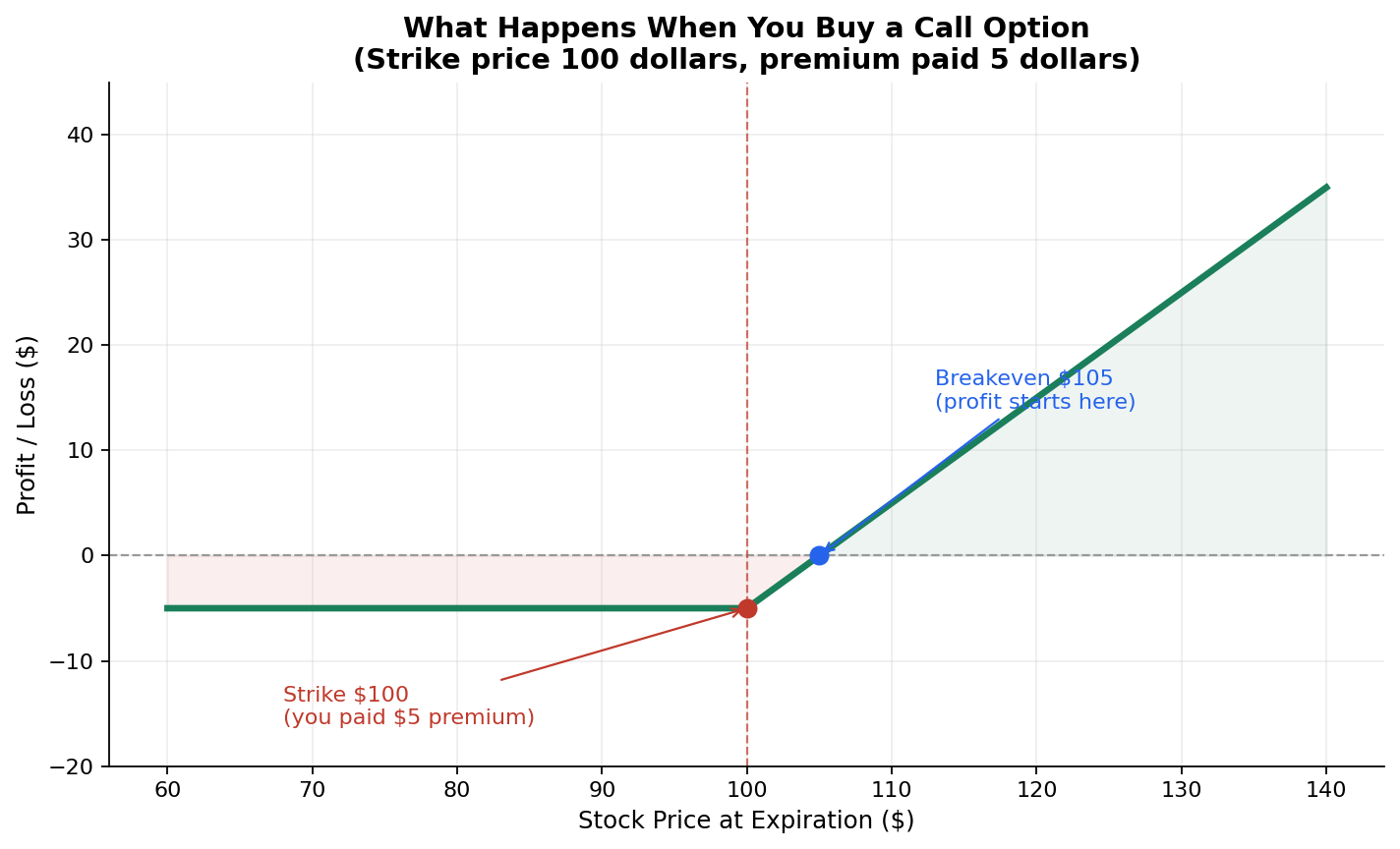
Here's the part that trips people up: every option has two sides. If you buy a call, someone else is selling that exact call to you. The buyer paid a price called the premium for that right. The seller collected that premium — and in exchange, took on an obligation if the buyer ever decides to exercise the contract. That asymmetry — one side has a right, the other has an obligation — is the single most important idea in this entire series. Everything else is built on top of it.
Think of it like an insurance policy. If you buy fire insurance on your house, you pay a premium, and you have the right to file a claim if your house burns down. The insurance company is on the other side — they collected your premium, and they have the obligation to pay out if a fire happens. You're not obligated to use the policy. They are obligated to honor it if you do. Options work the same way, just on stocks, indexes, and futures instead of houses.
Where Do Options Actually Trade? CME vs CBOE
This is where most beginner guides get vague, so let's be precise, because it matters for the rest of this series.
In the US, there are two exchanges you'll run into constantly:
CBOE (Chicago Board Options Exchange) is where most equity and index options trade. When you buy a call option on Apple stock, or an SPX option on the S&P 500 index, it's listed and traded on CBOE (or one of its competitor equity-options exchanges). CBOE was actually the exchange that invented standardized, exchange-listed options back in 1973 — before that, options existed but were privately negotiated, illiquid, and risky to trust.
CME (Chicago Mercantile Exchange) is where futures trade, and also where options on those futures trade. If you've ever heard someone mention E-mini S&P futures (ES) or crude oil futures, that's CME's territory. Crucially, CME doesn't just list futures — it also lists options on those futures contracts. So an option on an ES futures contract trades on CME, while an option directly on the S&P 500 index (SPX) trades on CBOE. Same underlying market, different products, different exchanges, different mechanics.
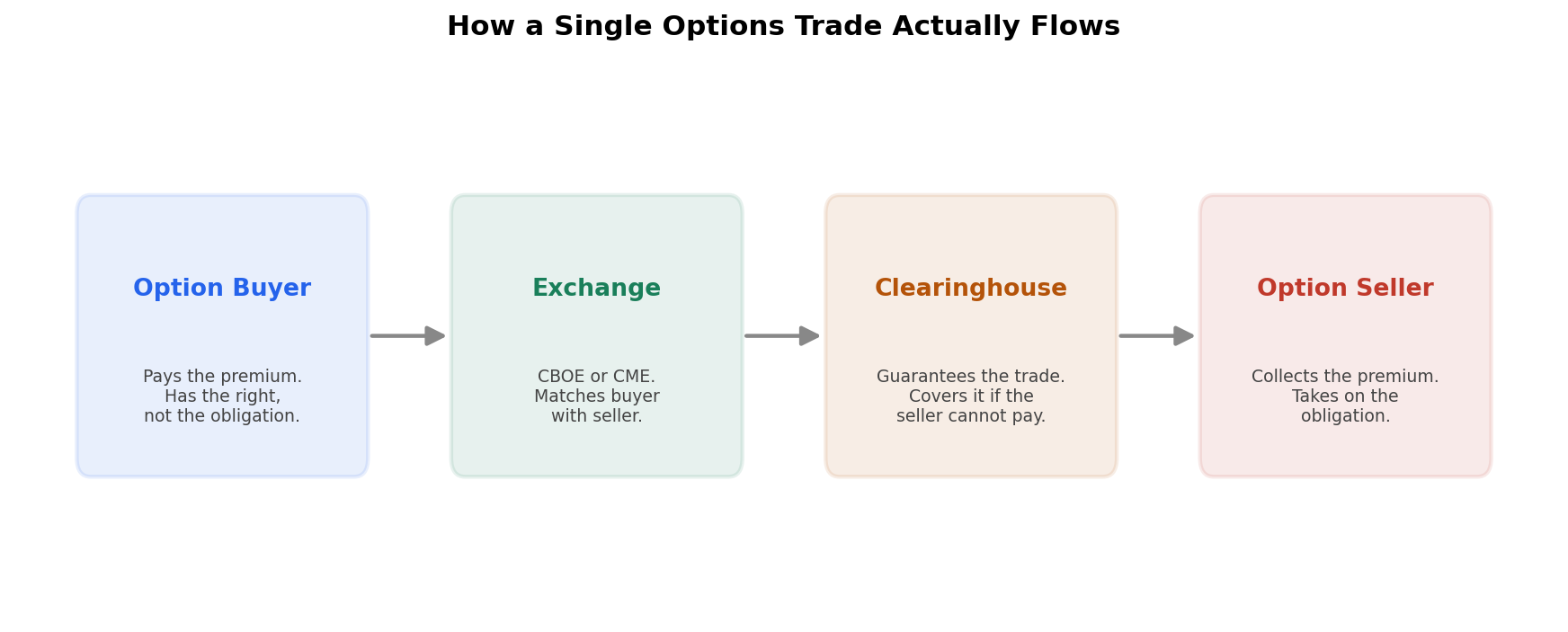
Exchange flow
Why does this distinction matter to a beginner? Two reasons:
Settlement differs. Equity options settle by actually delivering shares if exercised. Index options like SPX are cash-settled — no shares change hands, just cash based on the difference between strike and index value. Futures options can settle into a futures position rather than cash or shares. We'll go deep on this later in the series, but for now, just know: not all options settle the same way, and it depends on which exchange and product you're trading.
The clearinghouse guarantees every trade. Whether it's CME or CBOE, neither exchange lets you trade directly with the person on the other side of your contract. A clearinghouse sits in the middle, guaranteeing both sides perform. This is why options trading, despite sounding risky, doesn't carry the counterparty risk of a handshake deal — the clearinghouse has already made sure the other side can pay.
Equity Options
An equity option is an option where the underlying is a single stock — Apple, Tesla, Microsoft, whatever you can buy shares of, you can typically also trade options on (assuming there's enough trading volume to support a listed options market).
One standard equity option contract represents 100 shares of the underlying stock. So if you buy one call option on a stock trading at $150 with a $1.50 premium, you're paying $150 total ($1.50 × 100 shares) for the right to buy 100 shares at the strike price before expiration.
Equity options are usually physically settled — if you exercise the option, actual shares move into or out of your account. This matters because it means equity options carry a kind of "real world" weight that index options don't: someone, somewhere, ends up actually owning or delivering shares.
Index Options
An index option is based on an index — like the S&P 500 (SPX), Nasdaq-100 (NDX), or the Russell 2000 (RUT) — rather than a single company.
The critical difference: you can't buy or sell "the index" itself. There's no single security called "the S&P 500" sitting in a brokerage account. So when an index option is exercised, there's nothing to physically deliver. Instead, index options are almost universally cash-settled — the difference between the strike price and the index's value gets paid in cash, and that's the end of the transaction.
This is also why index options like SPX have become enormously popular for short-term, defined-risk trading: there's no risk of being unexpectedly assigned shares overnight, and the tax treatment in the US (under Section 1256) is often more favorable than short-term stock trading. We'll cover that nuance later in the series too — for today, just file away: index options settle in cash, equity options settle in stock.
Futures Options
This is the one that confuses people most, so let's be extra careful here.
A futures contract is itself an agreement to buy or sell something — corn, gold, the S&P 500 via an E-mini contract — at a future date, at an agreed price. A futures option is then an option on that futures contract. It's a derivative on a derivative, which sounds intimidating, but the logic is identical to everything above: you pay a premium for the right (not obligation) to enter that futures contract at a fixed price by a fixed date.
If you exercise a futures option, you don't get cash and you don't get shares — you get a futures position. That position then behaves exactly like any other futures contract, with its own daily mark-to-market and margin requirements.
Futures options trade on CME (for products like the E-mini S&P, gold, crude oil) rather than CBOE, which loops us back to the exchange distinction from earlier in this post. The regulatory split is mostly CFTC for CME futures products and SEC for CBOE-listed equity and index options — though the lines blur in places, which is exactly why this gets its own post later in the series. That's a deliberate detail I'm planting here, because by the time we get a few posts deeper into this series and start talking about why I personally trade SPX and ES options side by side, this distinction will matter a lot.
A quick real-world example to ground all of this: say you want exposure to a move in the S&P 500. You have three realistic choices — buy an option on SPY (an ETF that tracks the index, trading on a stock exchange, settled in shares), buy an option on SPX (the index itself, trading on CBOE, cash-settled), or buy an option on /ES futures (trading on CME, settling into a futures position). All three give you S&P 500 exposure. All three behave differently when it comes to settlement, contract size, and even taxes — SPX options, for instance, get blended long-term/short-term tax treatment under IRS Section 1256 regardless of how briefly you hold them, while SPY options don't. That's not a reason to rush into SPX tomorrow — it's a reason to understand what you're actually choosing between, which is the whole point of this series.
What's Coming Next in This Series
This post was deliberately just the map — knowing what an option is, and where the different types live. From here, the series builds in this order:
What is an option? (this post)
How options are priced — premium, intrinsic and extrinsic value
The Greeks: Delta, Gamma, Theta, Vega explained simply
Calls and puts — buying vs selling, and why selling is different
Defined-risk strategies: spreads, why and how
Iron condors and butterflies explained
0DTE options — what same-day expiry actually means
Index options vs equity options — practical trading differences
Risk management — position sizing, delta exposure, drawdowns
Building a systematic options framework (a peek at how I actually trade)
If you've made it this far and you're still a little unsure where to start practicing — that's completely normal. Nobody understands options on the first read. Subscribe below and I'll walk you through the next piece next week.
One ask before you go: I'd genuinely like to know where you're starting from. Have you traded options before, or is this entirely new territory? Is there a specific term or concept from this post that's still fuzzy? Drop a comment below — it'll directly shape what I dig into deeper as this series goes on, and if enough of you are stuck on the same thing, I'll write a dedicated post on it.